The Evolution of Yamaha's R-Series: From the 1998 R1 to Today's Supersport Family
BikersDunia Editorial Desk
October 31, 2026
12 min read • 2,750 words
Interactive R-Series Heritage Timeline (1998–2026)
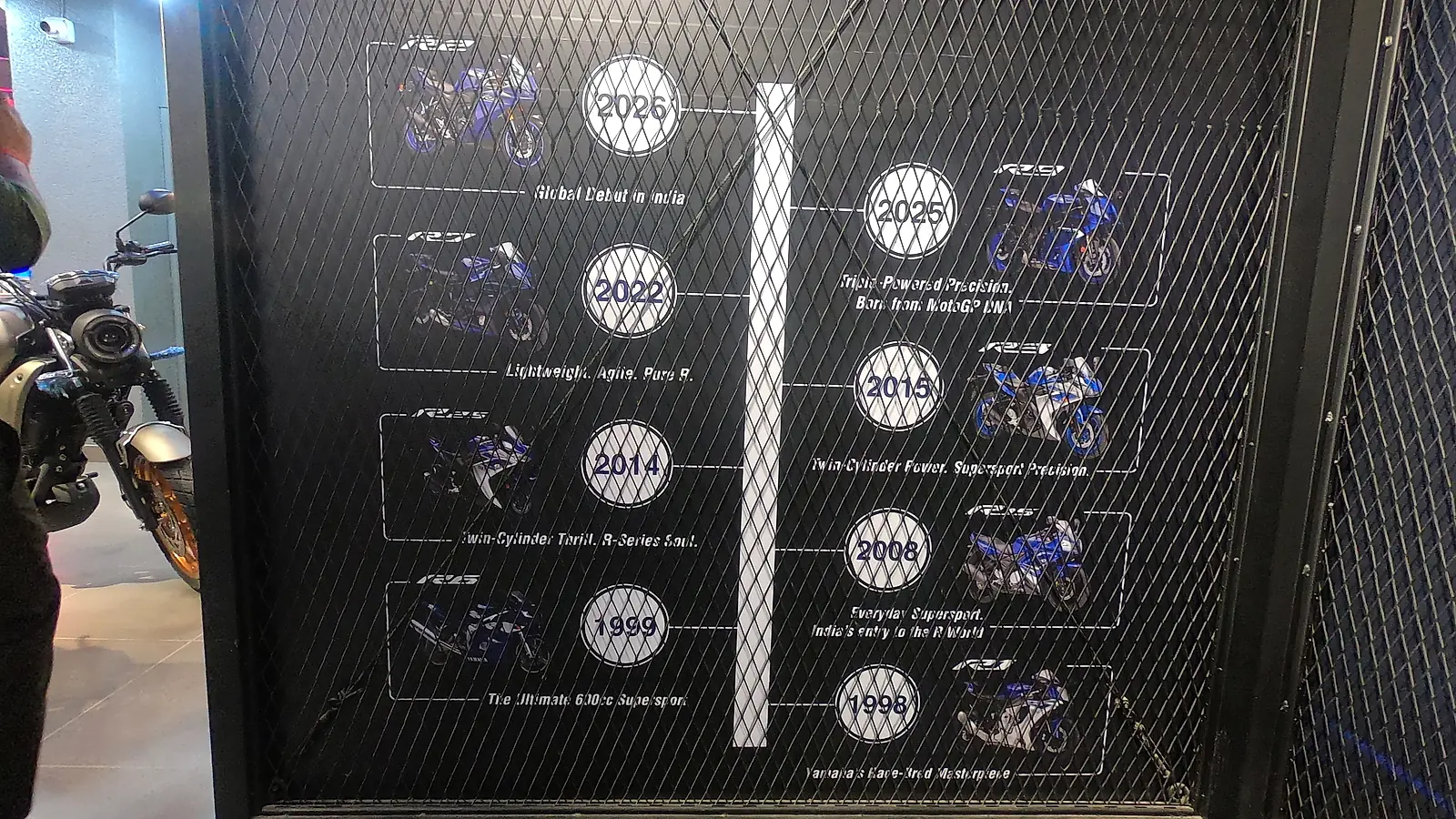
Select a milestone year to inspect engine architecture, chassis technology, and motorsport significance from the showroom wall installation:
2026: YZF-R2 Global Debut in India
Unveiled August 27, 2026: Yamaha chose India for the global premiere of the R2. 5-inch color TFT, traction control, and bi-directional quickshifter at ₹2.30L–₹2.53L.
204 cc DOHC 4V Single
26.5 PS @ 10,000 RPM • 149 kg kerb
High-Tensile Tube Diamond + Die-Cast Swingarm
Introduction: A Showroom Encounter with Living History
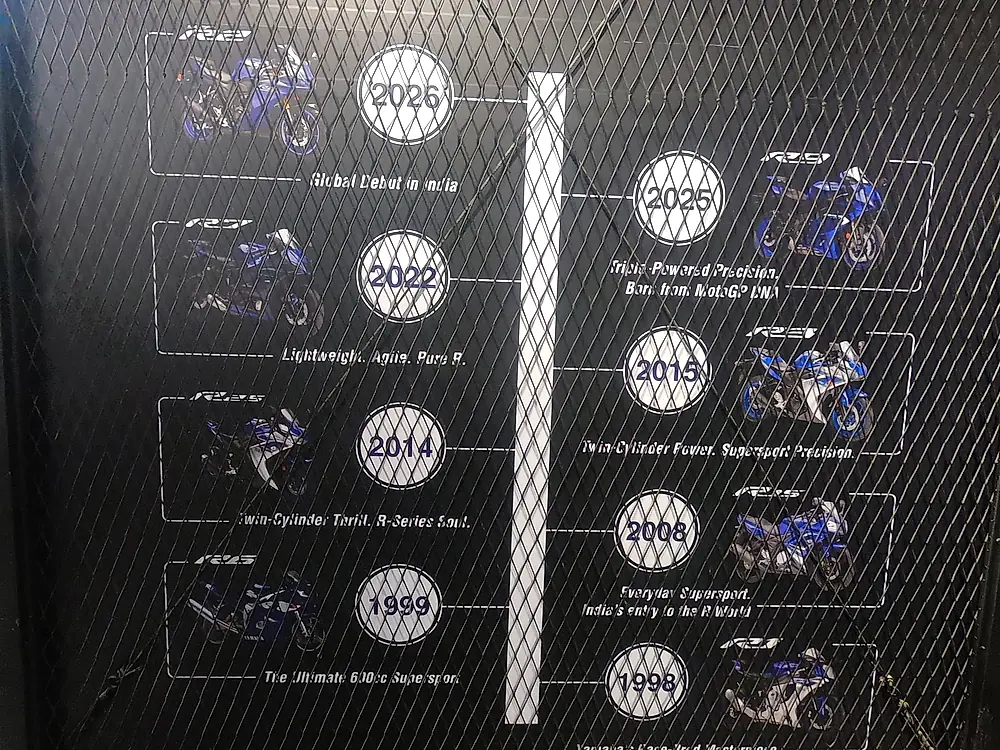
On October 31, 2026, while visiting a flagship Yamaha Blue Square showroom in India, our eyes were immediately drawn past the gleaming motorcycles on the polished floor to a striking, backlit architectural installation. Behind an industrial black diamond-mesh screen stood a towering, illuminated timeline wall charting the definitive history of Yamaha's supersport dynasty.
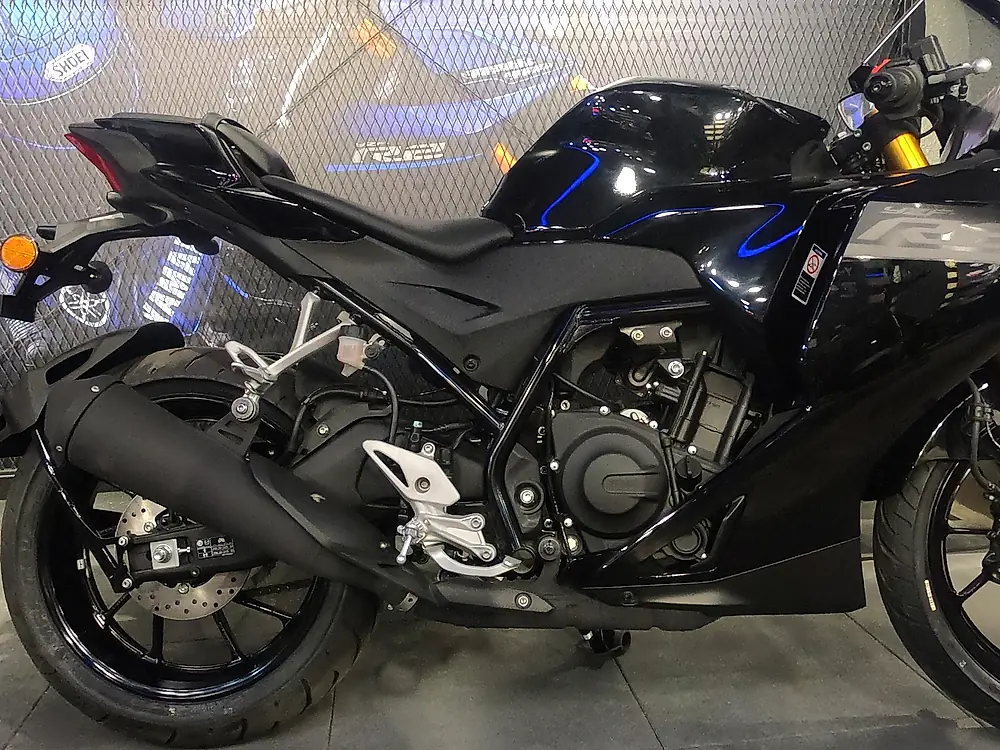
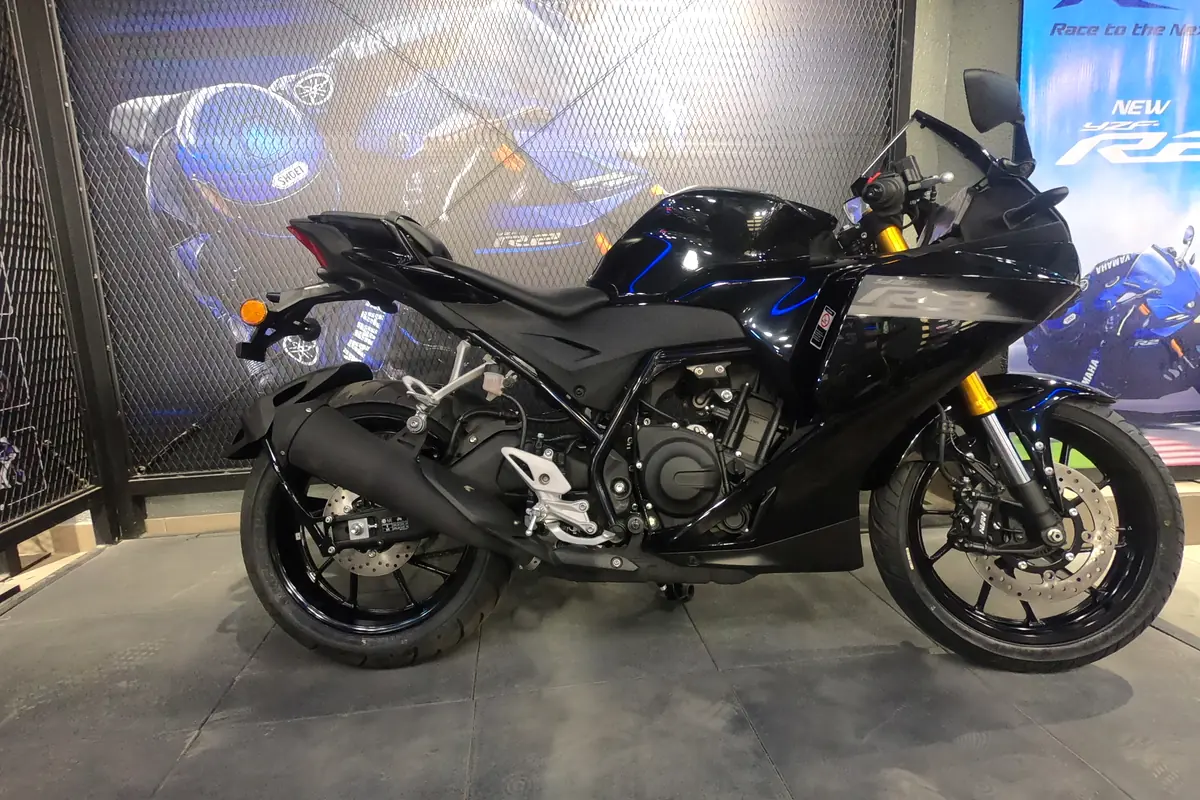
Titled simply across eight luminous nodes, the wall recorded a journey spanning nearly three decades—from the groundbreaking 1998 debut of the original YZF-R1 to the 2026 “Global Debut in India” of the all-new YZF-R2. Parked adjacent to this heritage display was a pristine, metallic black Yamaha YZF-R3, its gold-anodized inverted forks gleaming beneath the showroom halogens.
Standing between that timeline wall and the physical R3 in the showroom crystallized something fundamental about motorcycle engineering: Yamaha’s “R-World” is not merely a branding exercise. It is a continuous, uncompromising philosophical lineage where racetrack lessons learned at the highest tiers of world championship motorsport directly shape every street machine bearing the stylized “R” badge.
Chapter 1 — 1998: The Genesis of the Yamaha YZF-R1
To understand the modern sportbike landscape, one must return to the late 1990s. At the time, open-class liter-bikes were heavy, long-wheelbase machines prioritizing straight-line stability over cornering agility. Heavy engines dictated long chassis dimensions, making 1,000cc superbikes feel cumbersome when transitioning rapidly through tight chicanes.
In late 1997, at the EICMA motor show in Milan, project leader Kunihiko Miwa and his engineering team unveiled a motorcycle that detonated prevailing conventions: the 1998 Yamaha YZF-R1.
The Engineering Breakthrough: The Vertically Stacked Gearbox
By stacking the transmission shafts vertically above the countershaft, Kunihiko Miwa shrank engine length dramatically. This enabled a compact 1,395 mm wheelbase for laser-sharp turn-in, while allowing a disproportionately long swingarm that maintained ferocious corner-exit drive without unwanted wheelies.
With 150 PS from its 20-valve inline-four and a dry weight of just 177 kg, the 1998 R1 created the modern liter-class template that competitors spent the next decade attempting to match.
Chapter 2 — 1999: The Middleweight Scalpel — Yamaha YZF-R6
Having disrupted the open class, Yamaha set its sights on the fiercely contested 600cc supersport arena. In late 1998, for the 1999 model year, Yamaha unleashed the YZF-R6.
Where competitors built middleweights with compromise road-touring ergonomics, the R6 was conceived as a pure, uncompromising track weapon. Featuring an ultra-short-stroke 599cc inline-four with an astronomical 15,500 RPM redline, the 1999 R6 pushed out over 120 PS—becoming the first production 600cc motorcycle capable of producing 200 horsepower per liter in naturally aspirated trim.
Over the subsequent two decades, the R6 evolved into an untouchable road-racing legend, dominating the FIM Supersport World Championship with its telepathic Deltabox chassis geometry and unyielding high-RPM composure.
Chapter 3 — 2008: India’s Entry to the R-World — The Yamaha YZF-R15
In 2008, India Yamaha Motor pulled off one of the most consequential product launches in Asian motorcycling history: the Yamaha YZF-R15 (Version 1.0).
Prior to the R15, the Indian market was dominated by commuter transportation and air-cooled 150cc roadsters. Designed by the same Japanese team responsible for the flagship R-Series, the R15 brought genuine racetrack architecture to Indian riders:
- Aluminium Deltabox Frame: A rigid twin-spar perimeter chassis delivering unprecedented front-end feedback.
- Liquid-Cooled 4V Powertrain: 149.8cc single-cylinder engine paired with electronic fuel injection.
- Racing Metallurgy: Forged aluminium pistons and all-aluminium DiASil (Die-casting Aluminium-Silicon) cylinders offering three times greater heat dissipation.
Producing 17 PS and revving past 10,000 RPM, the R15 transformed Indian motorcycle culture, spawned the Yamaha One Make Championship, and nurtured an entire generation of Indian national racers.
Chapter 4 — 2014–2015: Parallel-Twin Expansion — The YZF-R25 & YZF-R3
By the early 2010s, a distinct gap opened between lightweight singles and the 600cc R6. In 2014, Yamaha responded with the YZF-R25 (249cc), followed in late 2014 by its global iteration, the YZF-R3 (321cc) for the 2015 model year.
The R3 was an engineering triumph of dual-purpose versatility: its 321cc parallel-twin engine used a 180-degree crankshaft, producing an energetic 42.0 PS at 10,750 RPM with virtually zero secondary vibration. Paired with sensible clip-on handlebar height and an accessible 780 mm seat, the R3 offered effortless 120 km/h expressway cruising and telepathic handling.
Chapter 5 — 2015: The Crossplane Revolution — The New-Generation YZF-R1
Drawing directly from Valentino Rossi and Jorge Lorenzo’s YZR-M1 MotoGP prototype, the 2015 R1 abandoned conventional liter-class design with a 998cc Crossplane Crankshaft (CP4) engine featuring an uneven 270°-180°-90°-180° firing order.
It became the world's first production street motorcycle fitted with a full 6-axis Inertial Measurement Unit (IMU) calculating lean angle, pitch, and yaw 125 times per second to govern banking-sensitive traction control, slide control, lift control, and launch control—setting a standard that all modern superbikes follow.
Chapter 6 — 2022: Pure R Dynamics — The Yamaha YZF-R7
As stringent Euro 5 emission regulations altered the supersport landscape, Yamaha introduced the YZF-R7. Powered by the proven CP2 689cc parallel-twin crossplane engine (73.4 PS, 67 Nm), the R7 prioritized corner-exit torque, accessible ergonomics, and lightweight agility (188 kg).
Housed in the narrowest fairing of any modern R-Series model with fully adjustable KYB inverted forks, the R7 proved that real-world accessible torque could deliver track thrills without exotic superbike expenses.
Chapter 7 — 2025: Triple-Powered Precision — The Yamaha YZF-R9
In October 2024, Yamaha answered enthusiast prayers by unveiling the 2025 Yamaha YZF-R9. Powered by the CP3 890cc crossplane inline-triple motor (119 PS, 93 Nm), it delivers low-end grunt combined with high-RPM musical scream.
Housed in the stiffest aluminium Deltabox chassis ever engineered for an R-model and adorned with wind-tunnel-developed functional aerodynamic winglets and 6-axis electronics, the R9 defines modern middleweight track performance.
Chapter 8 — 2026: The Yamaha YZF-R2 & The R-Series in India
This brings the heritage narrative directly to the top-left node of the showroom heritage display: “2026: Global Debut in India / YZF-R2”.
On August 27, 2026, Yamaha made international motorcycling history by choosing India as the global launchpad for the all-new Yamaha YZF-R2.
Sitting in the sweet spot between the 155cc R15 and 321cc R3, the production R2 features a 204cc liquid-cooled 4-valve DOHC single producing 26.5 PS at 10,000 RPM and 19.1 Nm at 8,000 RPM. Built on a lightweight high-tensile diamond chassis (149 kg kerb), it brings a 5-inch TFT, traction control, and bi-directional quickshifter to the sub-250cc segment at an aggressive ₹2,30,500 to ₹2,53,000 ex-showroom Delhi.
The Parallel Chapter: Yamaha YZF-R3 in India
Re-introduced in December 2023 as a CBU import from Indonesia, the Generation 2 R3 navigated steep import tariffs. Its initial ₹4.65 lakh price was corrected to ₹3.59 lakh in early 2025, and ultimately to ₹3,39,028 following the September 2025 GST rationalization on sub-350cc motorcycles. While factory import allocations halted in late 2025 to prioritize domestic manufacturing, physical inventory was not uniformly cleared, and select Blue Square dealerships continue to house remaining display units and demo bikes.
Chapter 9 — How R-Series Technology Evolved Across Three Decades
Comparing the machines across the showroom heritage wall reveals a continuous technological thread:
| Milestone | Engine Architecture | Frame Technology | Electronics & Aids |
|---|---|---|---|
| 1998 YZF-R1 | 998cc 20V Inline-4 | 1st-Gen Aluminium Deltabox | Pure Mechanical (Mikuni Carburetors) |
| 1999 YZF-R6 | 599cc 16V Inline-4 (15,500 RPM) | Aluminium Deltabox Perimeter | Pure Mechanical (Analogue Tachometer) |
| 2008 YZF-R15 | 149.8cc 4V SOHC Single (17 PS) | Aluminium Deltabox Chassis | Electronic Fuel Injection (EFI) |
| 2015 YZF-R3 | 321cc 8V Parallel-Twin (42 PS) | High-Tensile Steel Diamond | Multi-function LCD, Assist & Slipper Clutch |
| 2015 YZF-R1 | 998cc 16V CP4 Crossplane (200 PS) | Cast Aluminium Deltabox | 6-Axis IMU (Traction, Slide, Lift, Launch) |
| 2022 YZF-R7 | 689cc 8V CP2 Twin (73.4 PS) | Narrow Tubular Steel Backbone | Assist & Slipper Clutch, Optional Quickshifter |
| 2025 YZF-R9 | 890cc 12V CP3 Triple (119 PS) | Gravity-Cast Aluminium Deltabox | 6-Axis IMU, YRC Modes, Aerodynamic Winglets |
| 2026 YZF-R2 | 204cc 4V DOHC Single (26.5 PS) | High-Tensile Tube Diamond | 5" Color TFT, Ride-by-wire, TC, Bi-dir Quickshifter |
Chapter 10 — Why the Yamaha YZF-R3 Still Matters
In an automotive world increasingly dominated by digital riding aids, the Yamaha YZF-R3 stands out for its mechanical purity and accessibility.
The R3 was never designed to intimidate. It was engineered to flatter the rider. With its low 780 mm seat height, silky 180-degree twin-cylinder soundtrack, and forgiving raised clip-ons, it serves as the ultimate stepping stone. It teaches riders the art of carrying corner speed, trail-braking with chassis composure, and wringing out a high-revving engine without terrifying themselves with liter-class speeds.
Whether carving through the hills of Ooty, navigating the bumper-to-bumper crawl of Bengaluru, or stretching its legs on the Yamuna Expressway, the R3 remains one of the sweetest, most reliable, and deeply satisfying sportbikes ever built.
Conclusion: The R-World Never Stops
From the revolutionary packaging of the 1998 R1 to the accessible genius of the 2008 R15, the silky parallel-twin perfection of the R3, and the 2026 Indian debut of the R2—the R-Series has never stood still. Uncompromising racing DNA built for the street.
View Yamaha YZF-R3 Specifications & PriceFEATURED MOTORCYCLE
Yamaha YZF-R3
Last Recorded Price: ₹3,39,028 (Ex-Showroom)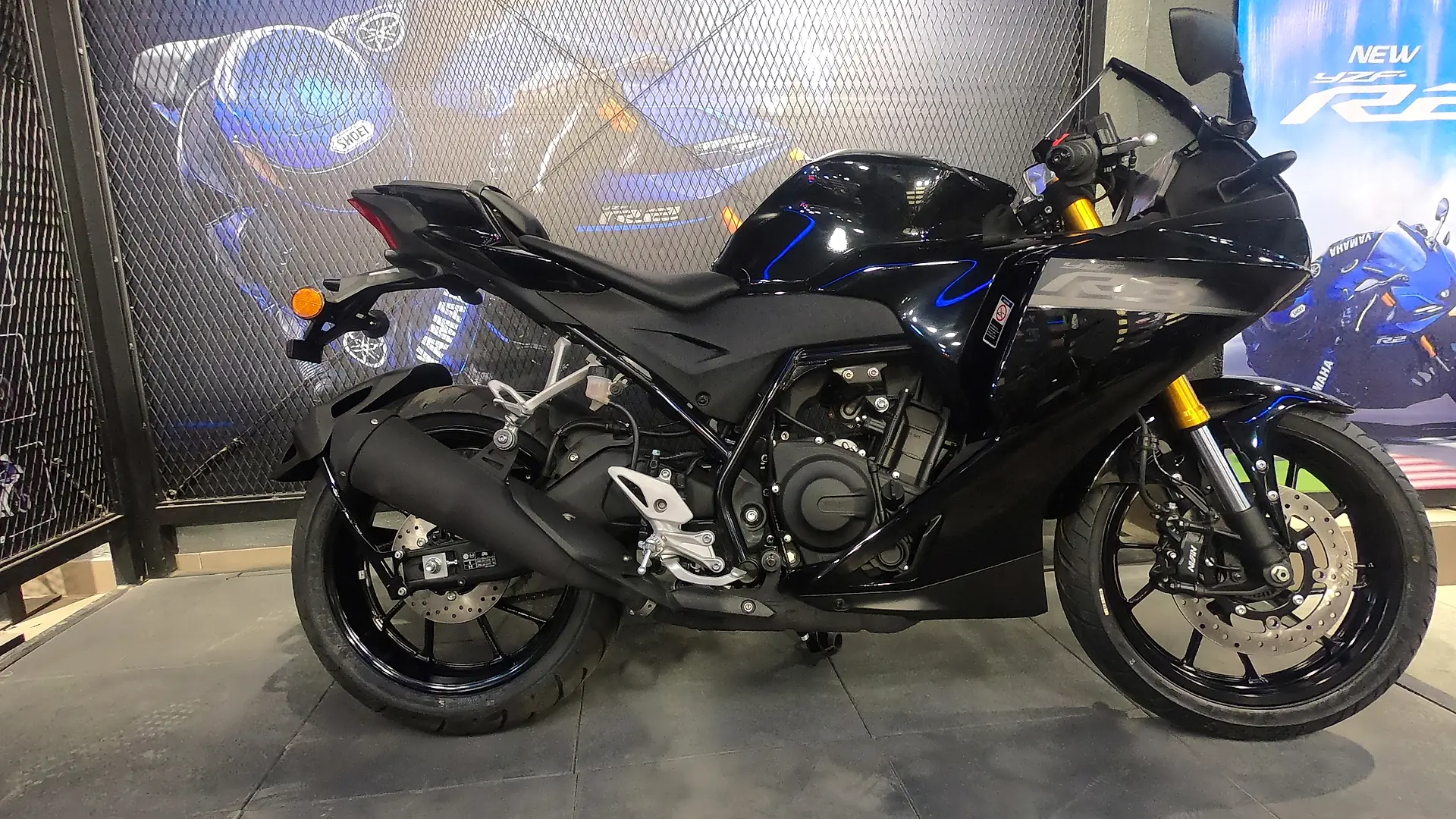
Showroom Provenance
Photographed on October 31, 2026 at an authorized Yamaha Blue Square facility in India. Unedited raw captures archived under GOPR1802.JPG and GOPR1819.JPG.